
About Us
Contrary to popular belief, Lorem Ipsum is not simply random text. It has roots in a piece of classical Latin literature from 45 BC, making it over 2000 years old.
Please fill out the form below and we will get back to you as soon as possible.
Contrary to popular belief, Lorem Ipsum is not simply random text. It has roots in a piece of classical Latin literature from 45 BC, making it over 2000 years old.
Oral cancer surgery is a specialized medical procedure performed to remove cancerous tissues from different parts of the mouth, including the tongue, inner cheek, gums, lips, and jaw.
Oral cancer surgery is a specialized medical procedure performed to remove cancerous tissues from different parts of the mouth, including the tongue, inner cheek, gums, lips, and jaw.
It is one of the most effective treatments for oral cancer, especially when the disease is detected at an early stage. The primary goal is to completely eliminate the tumor while preserving normal function.
Complete removal of cancerous cells with precision.
Focused on speech, chewing, and facial aesthetics.
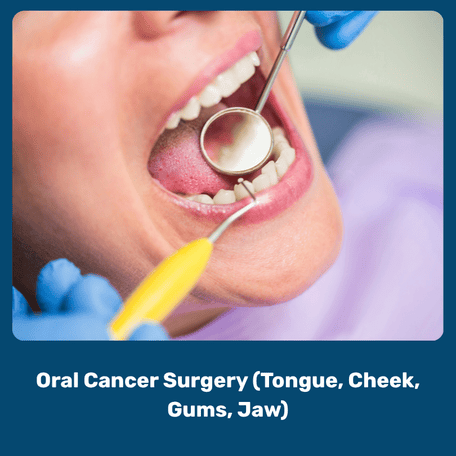
Oral cancer can develop in multiple regions, and each location requires a specific surgical approach.
Cancer often develops on sides of tongue causing pain issues
Inner cheek lining may develop ulcers swelling and cancerous growths
Cancer in gums can cause bleeding swelling and tooth loosening
Lip cancer appears as sores lumps or discoloration on lips
Area under tongue may develop swelling pain or cancerous lesions
Hard or soft palate may develop tumors affecting speech swallowing
Jawbone cancer affects structure causing pain swelling and facial deformity
Contact our oncology specialists for a comprehensive screening.
Before planning surgery, our oncology team performs a detailed diagnosis to confirm the precise stage and location of the cancer.
Thorough physical inspection of the mouth, throat, and neck area for visible anomalies.
A tissue sample is extracted and examined under a microscope for definitive confirmation.
Advanced CT scans, MRI, or PET scans to assess tumor size and potential spread (metastasis).
Comprehensive laboratory tests to evaluate the patient's overall health and surgical fitness.
These diagnostic tools are crucial in creating a personalized treatment plan tailored to the patient's specific needs.
Specialized surgical procedures designed to target cancer while preserving functionality and quality of life.
Removing part or all of the tongue. Partial glossectomy aims to preserve speech and swallowing functions.
Surgery for the lower jaw (mandible). Reconstruction is often done using bone grafts or implants.
Performed when cancer affects the upper jaw (maxilla), involving removal of the affected bone portion.
Complete surgical removal of the tumor along with a safety margin of healthy tissue.
Removal of lymph nodes in the neck to prevent the cancer from spreading further.
Restoring appearance and function using tissue grafts or flaps after tumor removal.

Early diagnosis saves lives. If you are experiencing any symptoms of oral cancer or need expert consultation, don’t delay.
Recovery is a personalized journey. While full recovery depends on the case complexity, here are the general guidelines our team follows to ensure your well-being.
Usually ranges from 5–10 days for monitoring and initial healing support.
Initial phase involves a liquid or soft diet to minimize strain on the surgical area.
Personalized medication plans are provided to manage discomfort effectively during healing.
If required, Speech and Swallowing therapy is provided to restore normal functions.
Consistent monitoring through scheduled visits ensures long-term recovery success.
Oral cancer surgery is a procedure to remove cancerous tissues from areas like the tongue, cheek, gums, or jaw. It helps eliminate the tumor and prevent the spread of cancer to other parts of the body.
The surgery itself is performed under anesthesia, so you will not feel pain during the procedure. After surgery, mild to moderate pain may occur, which can be managed with medications prescribed by your doctor.
Recovery time depends on the type of surgery and the stage of cancer. Most patients recover within 2 to 4 weeks, but complete healing and rehabilitation may take longer in complex cases.
In many cases, patients regain normal speech and eating abilities over time. However, if a large portion of tissue is removed, speech therapy and dietary adjustments may be required during recovery.
The success rate is higher when oral cancer is detected early. Early-stage oral cancer surgery has a high success rate, while advanced cases may require additional treatments like chemotherapy or radiation therapy.